How to start climbing at an indoor gym
A first visit to a climbing gym looks more intimidating from the outside than it feels from within. You do not need your own gear, a base level of fitness or any experience — you just need to know which kind of venue you are walking into and what to ask at the desk. And if you remember one sentence from this whole text, make it the one at the very end.
Two kinds of gym — and that is your first choice
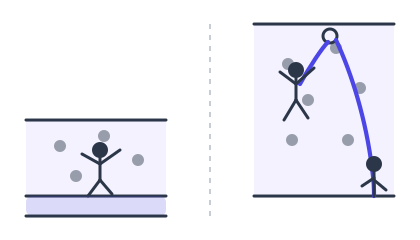
A bouldering gym means climbing without a rope, to about four and a half metres, over thick mats. You need no partner, no harness and no training: you pay for entry, get shoes and start. Getting down is part of the game too — you either downclimb on the holds or drop onto the mat, and that is worth learning from day one.
A rope wall means anything from ten to several dozen metres, and belaying. You need either a partner who can belay or a venue with auto-belay units, usually branded TruBlue. The unit takes in slack for you and lowers you to the ground when you let go, so it stands in for a second person.
Many venues have both under one roof, and that is the most convenient start: you can try both without changing address. The climbing-type filter on our map separates the three cases.
Shoes — the one thing that genuinely changes everything
A climbing shoe is nothing like a trainer. It has a stiff rubber sole wrapped around the toe and is deliberately smaller than your foot, so your toes curl slightly. That lets you stand on the very edge of the toe — an edge the size of a coin — instead of spreading your weight across the whole foot. It is the single change that makes climbing easier fastest.
For a first visit, rent shoes at the gym; practically every venue has them. Wear them barefoot or with a thin sock, and pick a size that is snug but not painful — your heel must not lift when you stand on your toes. If after ten minutes all you can think about is taking them off, they are too small, and nobody hands out medals for endurance here.
Do not buy shoes after your first session. Buy them once you are going regularly and know what actually bothers you.
Harness — only needed on a rope
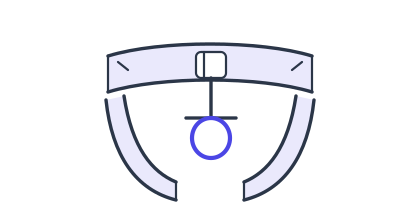
A sit harness is a waist belt and two leg loops joined at the front. Put it on so the belt sits above your hip bones, not on your waist and not on your stomach — once buckled, you should not be able to pull it down. Between the belt and the leg loops runs the belay loop: that is where the carabiner with the belay device clips, and nowhere else.
Harnesses can be rented on site too. Staff will help you fit one, and that is a normal part of a first visit — nobody expects you to bring your own.
Rope and knot
A climbing rope is dynamic: it stretches under load so a fall ends in a soft catch rather than a jolt. That is why no other rope will do — it is a certified product, not simply a cord of the right thickness. At a gym the rope is already there, running through the anchor, so you neither own nor carry one.
The rope is not clipped to the harness with a carabiner — it is tied, threaded through the two tie-in points: the upper one on the belt and the lower one on the leg-loop bridge. The knot taught in every first lesson is the rethreaded figure of eight.
And one thing reading cannot replace: do not learn the knot from a drawing or a video. This is exactly the skill that gets shown in person and then checked before every climb — first by you, then by your partner. We deliberately do not include a tying diagram here, because a badly tied knot “from a picture” looks almost exactly like a good one.
Belaying
Belaying means a second person feeds the rope through a device and holds its end with the brake hand at all times. The brake hand never lets go of the rope. That single rule is what everything else rests on, and it is the one moment in climbing where one person’s mistake is paid for by another.
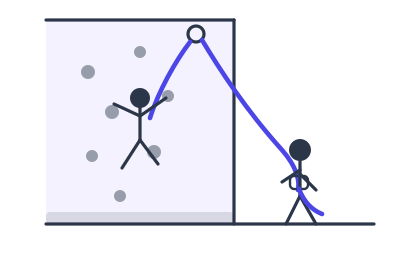
First sessions are almost always on top rope: the rope already runs through an anchor at the top, so if you come off you hang immediately, with virtually no fall. Lead climbing, where you clip the rope into protection as you go, comes much later and is a separate course.
The belay course cannot be skipped. Venues run it as a session of a few hours ending in a skills check, and without it they simply will not hand you a rope. If you have someone to climb with, sign up together — belaying works in pairs. And if you do not, bouldering or a venue with auto-belays is waiting: neither is a lesser version, just a different one.
What to bring on a first visit
Comfortable clothing you can lift a knee to your chest in, and socks. That is all you need to own — the rest can be rented. Chalk for sweaty hands becomes useful later; some gyms allow only chalk balls or liquid chalk, so ask before buying a bag of loose powder.
Take off your rings. A ring caught on a hold is one of the few ways to genuinely hurt yourself in a climbing gym. Tie long hair back and leave your watch in the locker.
And do not warm up by climbing at your limit. The first twenty minutes on the easiest routes will save you a week of sore fingers — the most common beginner injury, and one caused purely by enthusiasm.
How to read the routes
Holds of the same colour — or marked with tape of the same colour — form one route. You climb using only the holds of your colour; that is the game, and that is where the difficulty comes from. The rule for footholds varies: some gyms let you stand on anything, others only on your own colour. It is usually posted on a sheet by the entrance.
Rope route difficulty in Poland is given on the French scale, from 4 upwards. Bouldering gyms more often use their own colour scales. There is no single standard, so a “6” at two gyms is not always the same thing — treat your first visits as calibration, not as an exam.
Check the hours before you set off
It sounds obvious, and it is the most common reason for a wasted evening. Some gyms open only in the afternoon, some close early at weekends, and venues attached to clubs or universities may run in narrow windows. On top of that come route-setting days, when part of the wall is out of use.
On our map the “open now” filter shows only venues that should be open right now, and each gym’s page lists the full week. When a venue publishes no hours anywhere, we say so outright instead of guessing — then a phone call is the answer.
And now the part that matters
All that equipment is detail. Shoes get rented, staff fit the harness, an instructor teaches belaying, and the grading scales make sense by your third visit. None of it is a reason to postpone a first session until you are “fitter” or until you have “read up on it”.
Climbing has no entry barrier to clear first. At every gym there is someone who walked in for the first time today, someone who has just fallen off the easiest route, and someone sitting on the mat laughing about it. Nobody is watching how you are doing — everyone is looking at their own wall.
What counts is enjoying yourself and wanting to try. Turn up, have a go, ask somebody to show you a route, fall off a few times. The rest — strength, technique, gear, grades — arrives on its own, and far sooner than you think.